TL;DR
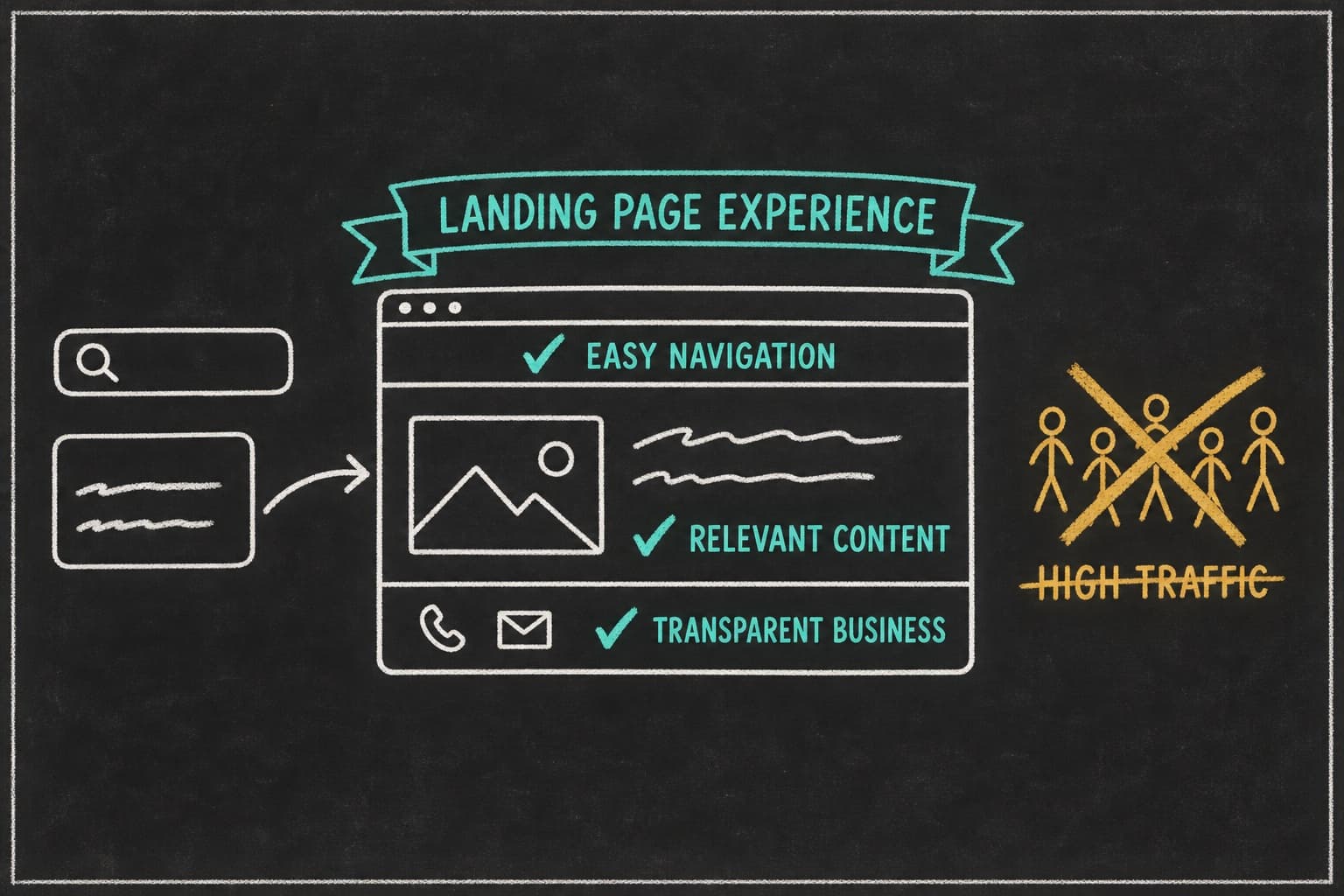
Three attributes describe a good landing page experience in Google Ads: relevant and original content, easy navigation, and transparency about the business. Google rates it per keyword against advertisers on the exact same search over the last 90 days. Quality Score, which it feeds, isn’t used in the auction.
Which attributes describe a good landing page experience? Google looks for three things on the page someone reaches after clicking your ad:
- Relevant, useful, original content that delivers what the ad and the search promised
- Easy navigation, so the visitor finds what they came for or takes the action you want
- Transparency about the business: who you are, what you sell, and how to reach you
“High amount of user traffic” is the wrong option: Google doesn’t rate a page on its traffic.
That’s the answer to the Google Ads Search certification question. (Some versions ask which attribute describes a good landing page experience, singular. Same answer.) Google doesn’t publish its exam key, but those three match its help center. The rest is for advertisers.
Key Takeaways
- Landing page experience is rated per keyword against advertisers whose ads showed for the exact same search over the last 90 days.
- Quality Score is a 1 to 10 diagnostic and “not an input in the ad auction.” Ad Rank uses auction-time quality measurements instead.
- Check the keyword before the page. Below average commonly means one URL serving several search intents.
Why those are the right answers: what Google says
Google’s About Quality Score page defines landing page experience as “how relevant and useful your landing page is to people who click your ad.” Search Ads 360 Help adds ease of navigation, the number of links on the page, and the expectations set by the ad.
Relevant, useful, and original content
Google’s example: someone who searches for flannel shirts and clicks an ad for flannel shirts should land on a page that features “your flannel inventory” (Google Ads Help). “Emergency plumber near me” should land on the service area and a phone number, not the homepage. Google also asks for “useful, original information” about what you advertise (Google Ads Help).
Easy to navigate
On February 5, 2025, Google announced “a new prediction model” that helps its ads quality systems “more precisely capture the quality of your navigation experience” (Google). Its example: someone looking for a login page clicks an ad, lands on a promotion, and can’t find the login link. Google said it can now “show you fewer ads like this.”
Does that contradict CRO advice to strip the navigation? Not really. A focused, no-nav page is fine when it’s the right page for the query. The problem is a promo page with no way out, shown to someone who searched for something else.
Transparent about the business
Google advises: “It’s a good idea to openly share information about your business and clearly state what it does.” It adds that easy contact builds trust, and that forms asking for personal information should say why (Google Ads Help). In practice: a business name, contact details, clear pricing or terms, and a privacy policy next to any form.
How landing page experience fits into Google Ads Quality Score
Quality Score is “a diagnostic tool meant to give you a sense of how well your ad quality compares to other advertisers,” scored 1 to 10 per keyword in Search campaigns. It combines three components:
| Component | What Google says it measures | Where you fix it |
|---|---|---|
| Expected CTR | “The likelihood that your ad will be clicked when shown” | Ad copy, keyword choice |
| Ad relevance | “How closely your ad matches the intent behind a user’s search” | Ad group themes, ad copy |
| Landing page experience | “How relevant and useful your landing page is to people who click your ad” | The page, and which keywords point to it |
Each status (Above average, Average, Below average) comes from “a comparison with other advertisers whose ads showed for the exact same search over the last 90 days.” Three things follow:
- It’s per keyword. One URL can hold different ratings on different keywords.
- It’s relative. It can drop while your page stays the same.
- It looks back 90 days. A fix won’t show up the next morning.
Quality Score is a diagnostic, not an auction input
Most guides get this wrong. Google says “Quality Score is not an input in the ad auction,” and that it “should not be optimized or aggregated with the rest of your data.”
The auction runs on Ad Rank. Google says “the Ad Rank calculations incorporate your bid and auction-time quality that can include auction-time measurements like expected CTR, ad relevance, and landing page experience, among other factors” (About Ad Rank).
So the page matters in the auction, and the 1 to 10 number doesn’t. Think of Quality Score as a historical summary of signals the auction measures fresh each time. Meta and TikTok have no Quality Score at all, one of the ways landing page requirements differ across ad platforms.
Where to find your landing page experience rating
Open Keywords under Campaigns, click the columns icon, open the Quality score section, and add “Landing Page Exp.” A dash means there aren’t enough searches that exactly match the keyword to score it.
How to fix a Below average landing page experience
Check the keyword, not just the page
Below average usually means a keyword that doesn’t belong on that page. Loosely themed ad groups send several intents to one URL, and the page can only answer one.
Take a hypothetical account run by a media buyer named Dana, for a payroll software company. One ad group sends “payroll software for restaurants,” “payroll software pricing,” and “payroll login” to a demo request page. Landing Page Exp. reads Average on the first and Below average on the other two.
The page isn’t broken. The pricing searcher wanted prices, and the login searcher wanted to log in. Dana points pricing at the pricing page, gives restaurants its own ad group and page, and adds “login” as a negative keyword. Each search gets the page that answers it, the same logic behind choosing a landing page vs product page for paid traffic.
Build one landing page per ad group theme
Google’s advice is to “choose a landing page that closely matches your ad and keywords” (Google Ads Help). That’s message match: carry the ad’s offer, wording, and call to action onto the page. If the ad promises a free trial, the page leads with the free trial.
Every page used to need a brief, a designer, and a developer. Pagedeck builds a matching landing page for every ad: point it at the ad and it carries over the offer, the angle, and the creative. No tool can promise the rating, since Google grades you against whoever else showed on that search. A matched page does retire the one-page-for-every-keyword setup.
Fix mobile and load basics
- Mobile rendering. In the Google Ads Landing pages report, a “Mobile-friendly click rate” under 100% means some clicks reached a page Google didn’t rate as mobile-friendly. See mobile-first landing page design.
- Load and flicker. Google reports that “in retail, we’ve seen that a 1-second delay in mobile can impact mobile conversions by up to 20 percent” (Google Ads Help), a conversion effect rather than a rating one. Compress images, cut render-blocking scripts, and use server-side A/B testing on landing pages so tests don’t swap content after the page appears.
Make sure Google can crawl the page
Google says “information obtained from any of Google’s various crawlers may be used to assess ad quality.” AdsBot-Google, which checks ad landing pages, has a quirk: “The global user agent (*) is ignored,” but a robots.txt rule naming AdsBot-Google does block it (Google Search Central). Check for that rule, plus login walls, redirect chains, and geo-blocking. Google’s destination requirements rule out uncrawlable pages.
Know when to leave it alone
A Below average keyword that converts at a cost per conversion you’re happy with can wait. Fix the unprofitable keywords first.
Frequently asked questions
What makes a landing page effective?
It matches the ad that sent the visitor and makes the offer worth more than the cost, risk, and effort of acting. For Google Ads, add relevance to the search, easy navigation, and transparency. More in what makes a high-converting landing page.
How do I improve landing page experience in Google Ads?
Start with keywords rated Below average in the Landing Page Exp. column. Move keywords the page doesn’t answer to their own ad group and page. Then check transparency, mobile rendering, load speed, and crawl access.
Does landing page experience affect cost per click?
It can. Landing page experience is one of the auction-time quality measurements in Ad Rank, and Google says “higher quality ads can often lead to lower CPCs” (About Ad Rank). The 1 to 10 Quality Score itself isn’t an auction input, so it doesn’t set your actual CPC.
Is Quality Score used in the ad auction?
No. Google states “Quality Score is not an input in the ad auction.” The auction uses Ad Rank, which draws on your bid, auction-time measurements of the same three components, and the context of the search.
Conclusion
Which attributes describe a good landing page experience? Relevant, original content, easy navigation, and transparency about the business.
For advertisers, the fix usually starts with which keywords point at which page. If several ad groups share one page, build your first page free, no credit card needed. Point Pagedeck at the ad and it builds the matching page.